

Can You Wear Jewelry Through Airport Security? What Sets Off the Alarm

Yes, you can wear jewelry through airport security. The TSA does not require travellers to remove rings, earrings, necklaces, bracelets or watches, and jewelry is not on the mandatory removal list. Bulky or heavily metallic pieces can still trigger a metal detector and lead to secondary screening.
The useful question is not whether you may wear it. It is whether the piece you have on is likely to cost you five minutes and a pat-down.
What Actually Triggers an Alarm

The answer is less about what the piece is worth and more about how much metal it contains and how it is distributed. Two pieces of similar value can behave completely differently at the same lane.
Walk-through metal detectors respond to mass and conductivity rather than to value. A thin gold chain or a wedding band passes without comment. A heavy chain, a stacked cuff, a chunky watch or several rings worn together can produce a strong enough signal to alarm.
Cheap costume jewelry is more likely to set off a detector than expensive fine jewelry, which surprises people. Fine gold and platinum pieces tend to be small and dense, while costume pieces are often large and made from base metals that read strongly.
| Item | Likely outcome | Recommendation |
|---|---|---|
| Wedding band, thin rings | Passes | Keep it on |
| Stud earrings, small hoops | Passes | Keep them on |
| Fine chain necklace | Usually passes | Keep it on |
| Heavy chain or statement necklace | May alarm | Put it in your carry-on |
| Metal watch | May alarm | Bag it before the lane |
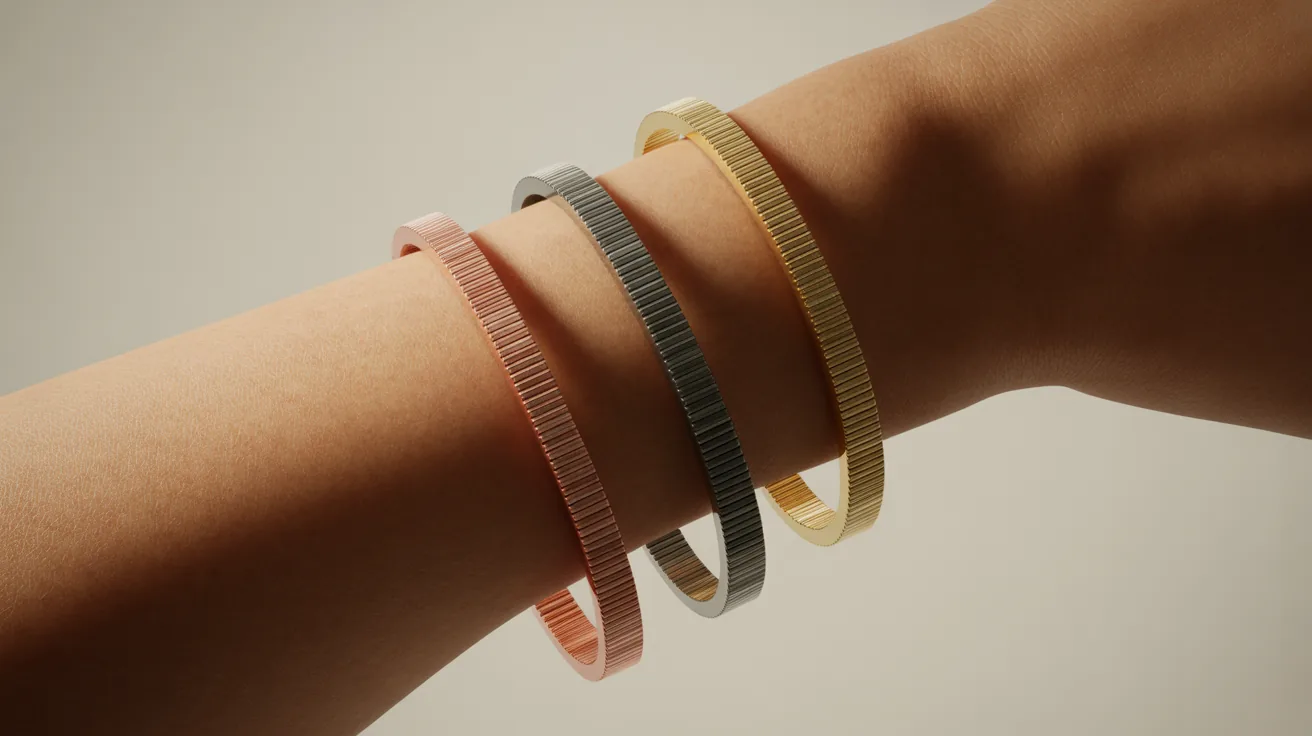
| Stacked bangles or cuffs | Often alarms | Put them in your carry-on |
| Permanent welded bracelet | Passes | Keep it on |
| Body piercings | Usually passes | Tell the officer if asked |
Body Scanners Versus Metal Detectors
Which machine you go through changes the odds more than what you are wearing does, and you do not get to pick the lane.
Layering is what tips a borderline case over. Three thin bracelets read as one larger object, and a watch worn next to a bangle does the same. Spreading pieces across both wrists, or moving one into your bag before the lane, is usually enough to keep the alarm quiet.
Most US checkpoints now use millimetre wave body scanners rather than walk-through metal detectors. These produce a generic outline showing where something is detected, and they respond to shape and density rather than to metal alone. Jewelry frequently shows on the image, and officers usually identify it as harmless without further action.
Where you go through a traditional metal detector, which is common in PreCheck lanes and at many airports abroad, the older sensitivity rules apply and heavy pieces are more likely to alarm. You do not get to choose which lane you are sent to, so pack for the stricter one.
🔢 Quick Numbers
- Zero jewelry items appear on the TSA’s mandatory removal list for the checkpoint (TSA screening guidance)
- 3.4 ounces (100 ml) is the limit on jewelry cleaning solution or any other liquid in the same bag (TSA liquids rule)
- Airlines exclude jewelry and other valuables from checked baggage liability, so it should never leave your sight (airline conditions of carriage)
Never Put Jewelry in Checked Baggage
Of everything in this article, this is the part with real money attached to it, and it is also the easiest to act on.
Smart jewelry sits slightly apart from the rest. Pieces containing a battery or electronics, including some fitness rings and connected bracelets, may be screened as devices rather than as jewelry, and officers can ask to look at them separately. It is a short conversation rather than a problem, but it is worth allowing for if you tend to move through airports at the last minute.
This is the part that matters more than the alarm question. Airlines list valuables among the items carried at the passenger’s own risk, which means a ring lost from a checked bag is very unlikely to be compensated. Travel insurance policies usually cap valuables at a figure well below what an engagement ring is worth, and many exclude items left unattended.
A checked bag is unattended by definition. Whatever you would be genuinely upset to lose stays on your body or in the bag you carry.
⚠️ Common Mistake to Avoid
The specific mistake is taking a ring off and dropping it loose into a security tray. Trays are the single most common place jewelry goes missing at an airport, because they travel down a belt while you are held at the scanner. If a piece has to come off, put it inside your carry-on bag or a zipped pocket before the bag goes on the belt, never loose in the tray.
Travelling With Valuable Pieces
The practical question is whether a piece travels on you or in a bag, and the answer is usually on you.
Wearing it is usually the better option in any case. Jewelry on your body cannot be left in a tray, forgotten in a seat pocket or lost with a bag, and the small risk of a pat-down is a fair trade for that. The exception is anything genuinely irreplaceable, which is worth thinking about before the trip rather than at the airport, in the same way you would plan around anything else you cannot easily replace.
If you are carrying jewelry rather than wearing it, a small zipped travel case in your personal item is the right home for it. It keeps everything in one place, it can be lifted out in one motion if a bag is opened, and it stops a chain tangling with a charger cable.
For high value items it is worth checking your home insurance before you go, since many policies cover personal possessions away from home only up to a limit or only with an added clause. Insurers also ask for a recent valuation, so the time to sort it out is before the trip rather than after a loss. Documentation of this kind sits alongside the other trip records worth keeping accessible on your phone.
Rules and Sensitivities Abroad
Screening technology varies more than the rules themselves do. Airports without body scanners rely on metal detectors that alarm more readily, and secondary screening with a handheld wand is routine rather than exceptional. Nothing about that should worry you, but it does mean allowing time.
Cultural and religious jewelry is accommodated everywhere, and officers can usually arrange a private screening if a piece cannot be removed. Airports publish their own screening guidance and airlines list restricted items separately, so a quick look at both is sensible before a trip where you are carrying something significant.
ℹ️ Good to Know
Customs is a separate question from security when you are carrying valuable jewelry across a border. Several countries require declaration of goods above a value threshold, and returning home with an expensive purchase can attract duty. Carrying a receipt for anything bought abroad, and knowing your home country’s allowance, avoids an awkward conversation at arrivals.
Screening procedures and airline liability terms differ by country and carrier and change over time. Check your airline’s conditions of carriage and your insurance policy before travelling with valuable items.

Leave a Comment